
SEO vs GEO: Understanding the Future of Digital Visibility
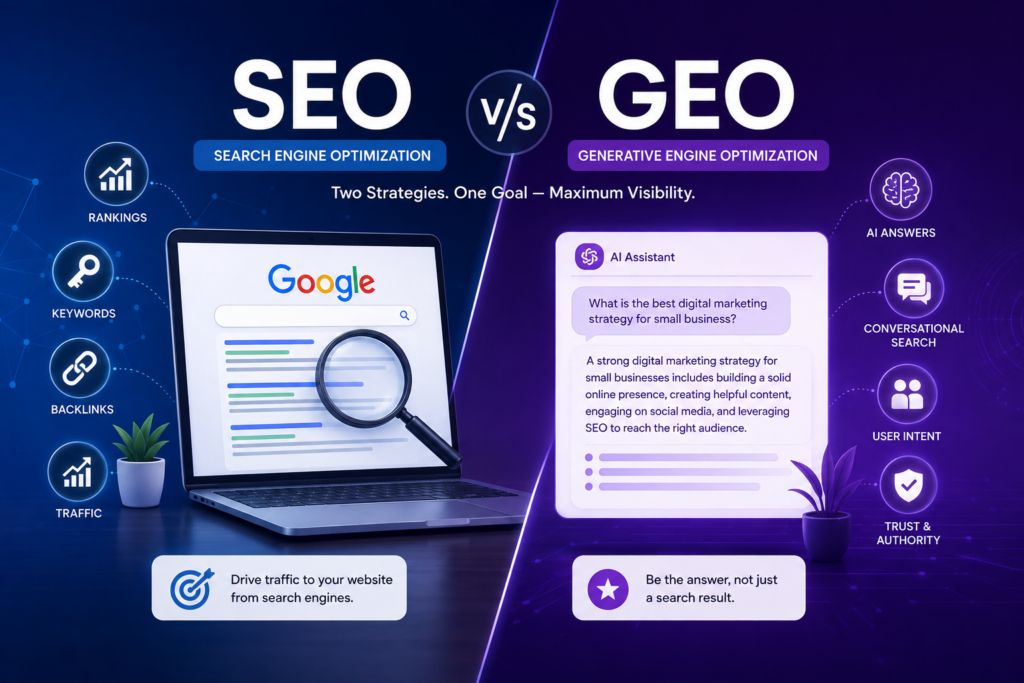
This blog is explaining about “Difference between SEO&GEO” Businesses need to modify their digital marketing tactics as artificial intelligence changes how people look for information online. Traditional Search Engine Optimization (SEO) has long been the foundation of online visibility, helping websites rank higher on search engines like Google and Bing. Today, a new approach called Generative Engine Optimization (GEO) is becoming increasingly important as AI-powered search tools such as ChatGPT, Google AI Overviews, Gemini, and Perplexity change the way users discover information.
Businesses that wish to remain competitive in the rapidly changing digital landscape must comprehend the distinction between SEO and GEO.
What is SEO?
Search Engine Optimization (SEO) is the process of improving a website so that it ranks higher in search engine results pages (SERPs). The primary goal of SEO is to attract organic traffic by making your website more relevant and trustworthy for specific search queries.
SEO involves several important practices, including:
Keyword research and optimization
High-quality content creation
Technical website optimization
Mobile-friendly website design
Fast page loading speed
Internal and external link building
Local SEO optimization
User experience improvements
What is GEO?
Generative Engine Optimization (GEO) is the practice of optimizing your content so that AI-powered search engines and generative AI platforms use your information when generating answers for users.
Unlike traditional search engines that provide a list of links, AI search tools generate direct answers by analyzing multiple trusted sources. GEO focuses on making your content accurate, well-structured, authoritative, and easy for AI systems to understand.
Popular AI platforms include:
- ChatGPT
- Google AI Overviews
- Google Gemini
- Microsoft Copilot
- Perplexity AI
Key Differences Between SEO and GEO
| Feature | SEO | GEO |
|---|---|---|
|
Goal |
Rank higher on search engines |
Be referenced by AI-generated answers |
|
Platform |
Google, Bing, Yahoo |
ChatGPT, Gemini, Perplexity, AI Overviews |
|
Focus |
Keywords and rankings |
Context, authority, and trustworthy content |
|
Results |
Website links |
AI-generated summaries and citations |
|
Content Style |
Keyword-optimized pages |
Comprehensive, structured, conversational content |
|
Success Metric |
Organic traffic |
AI visibility, mentions, and citations |
SEO and GEO Work Together
Many people believe GEO will replace SEO. In actuality, the two approaches work well together
SEO helps search engines discover and rank your website, while GEO helps AI systems understand and reference your content. Businesses that combine both approaches have a better chance of reaching users through both traditional search and AI-powered experiences.
For the best results:
Create original, valuable content.
Use clear headings and logical structure.
Answer common user questions.
Support claims with reliable information.
Update content regularly.
Improve page speed and user experience.
Build authority through quality backlinks and expertise.
Why GEO matters in 2026
User search behavior is changing rapidly. Instead of browsing multiple websites, many users now ask AI assistants for direct answers.
For example, instead of searching:
*”Best SEO tips for beginners”*
Users may ask:
*”How can I improve my website ranking without paying for ads?”*
AI tools generate a detailed response using information from trusted websites. If your content is optimized for GEO, your website has a better chance of being referenced in those responses, increasing your brand visibility and authority.
Best Practices for SEO & GEO
To succeed in both traditional and AI search, follow these best practices:
- Publish helpful, original, and accurate content.
- Write naturally while addressing user intent.
- Use descriptive headings and subheadings.
- Include FAQs that answer common questions.
- Add structured data where appropriate.
- Keep information up to date.
- Demonstrate expertise and credibility.
- Optimize website performance and mobile usability.
Conclusion
SEO and GEO are not competing strategies—they are complementary. SEO ensures your website ranks well in search engine results, while GEO increases the likelihood that AI-powered search tools will reference your content in generated answers.
As AI continues to reshape online search, businesses that invest in both SEO and GEO will be better positioned to attract traffic, build authority, and stay ahead of the competition. The future of digital marketing belongs to brands that optimize for both search engines and generative AI, ensuring their content remains visible wherever users seek information.